further chem
linked to transition metal properties, 2.3.1 and 2.3.2 metallic bond
ligand field theory
- includes covalent aspects of bonding between metals and ligand
CFT
-
assumes that the metal-ligand bond is ionic
-
assumed that the ligands are negative point charges
i.e. the lone pairs on the ligands are essentially points at which there is a concentration of negative charge -
the structure or the specific atoms in the ligands are not considered
-
consider the repulsion between negative point charges and d-orbitals
d-electron count: number of d electrons in d orbitals
coordinate covalent bonds forms between transition metal ion (Lewis acid) and ligand (lewis base)
crystal field splitting
spherical crystal field describes a situation where the transition metal is surrounded completely, equally by ligands, so all the orbitals are destabilised by the same amount, and experience the same amount of repulsion, and all go up to the same energy
as ligands approach from different directions, the degenerate
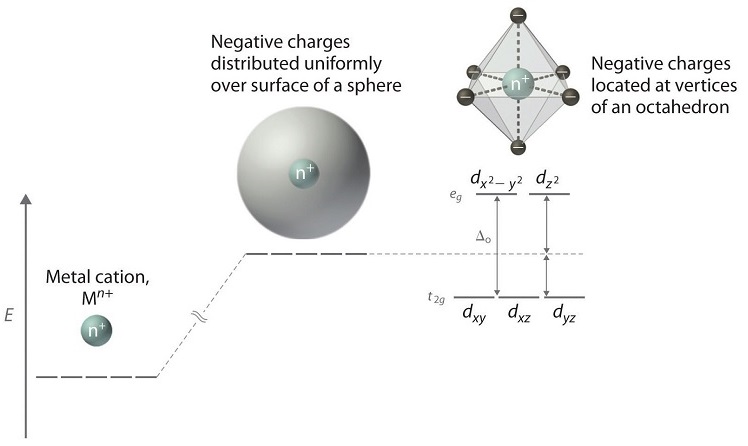
distributing a charge of −6 uniformly over a spherical surface surrounding a metal ion causes the energy of all five d orbitals to increase due to electrostatic repulsions, but the five d orbitals remain degenerate.
this is also known as the isotropic field
Placing a charge of −1 at each vertex of an octahedron causes the d orbitals to split into two groups with different energies:
-
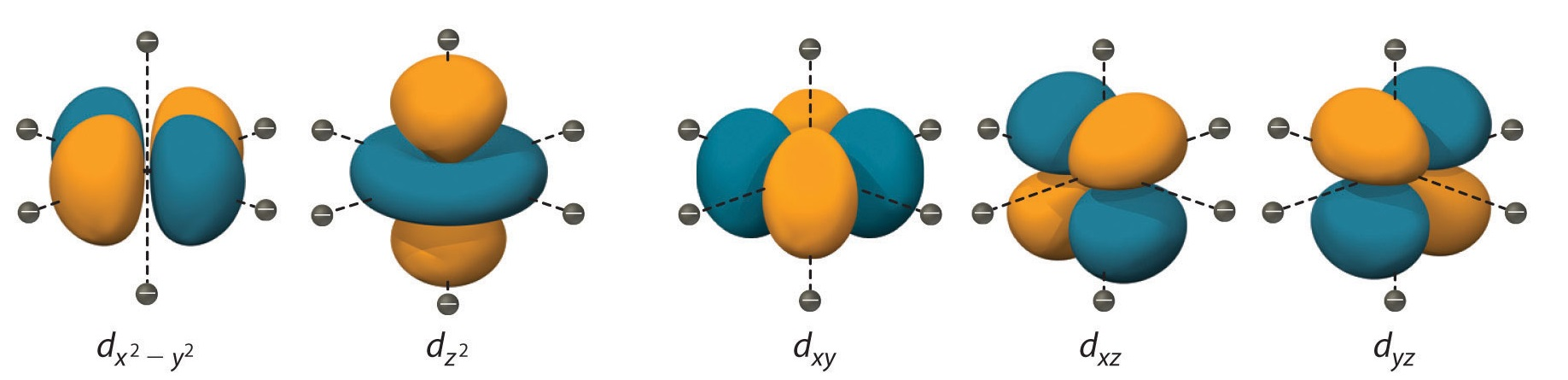
set most direct repulsion: and -
set less repulsion: , , -
average energy of 5
-orbitals are still the same as the spherical distribution
the energy between the two sets is known as
- according to the Aufbau principle, electrons are filled from lower to higher energy orbitals
- following Hund’s rule, electrons are filled to have the highest number of unpaired electrons
- the pairing of the electrons requires spin pairing energy
- if the pairing energy is less than
, then the higher energy orbital can fill - otherwise, the electron will go into the higher energy orbital due to stability
strong field ligands produce a large crystal field splitting
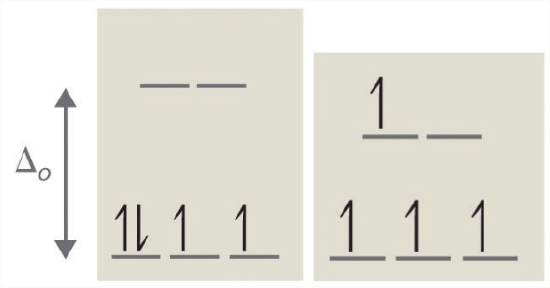
splitting for a
left: low spin, strong field ligand,
right: high spin, weak field ligand,
spectrochemical series gives strength of ligands

generally, the oxidation state and strength of ligands determine splitting
the amount of energy the electrons have to gain determines the wavelength of electromagnetic radiation the complex will absorb
the spin state determines if the complex is paramagnetic or diamagnetic
- high-spin complexes are paramagnetic (many unpaired electrons)
- low-spin complexes are diamagnetic (few unpaired electrons)
tetrahedral complexes
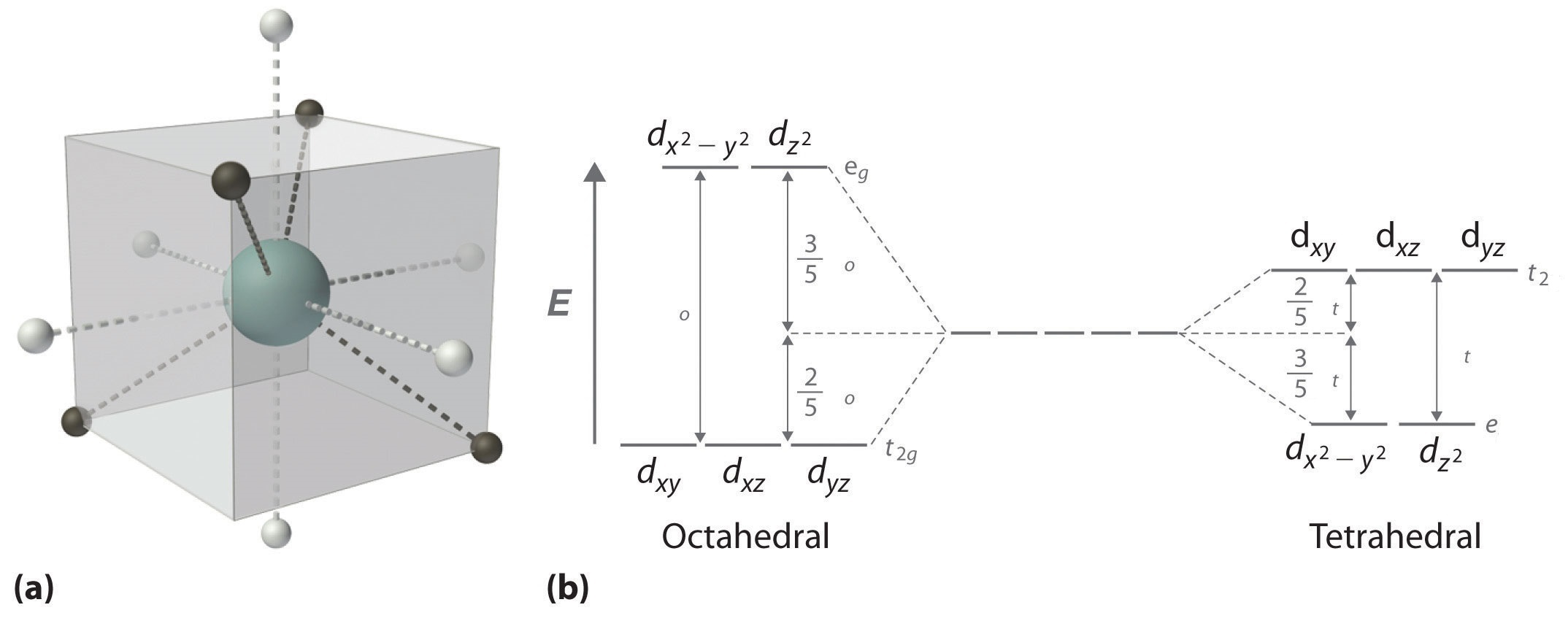
note:
calculating the magnetic moment of a given TM complex
where:
is the number of unpaired electrons is the magnetic moment in units of is a physical constant
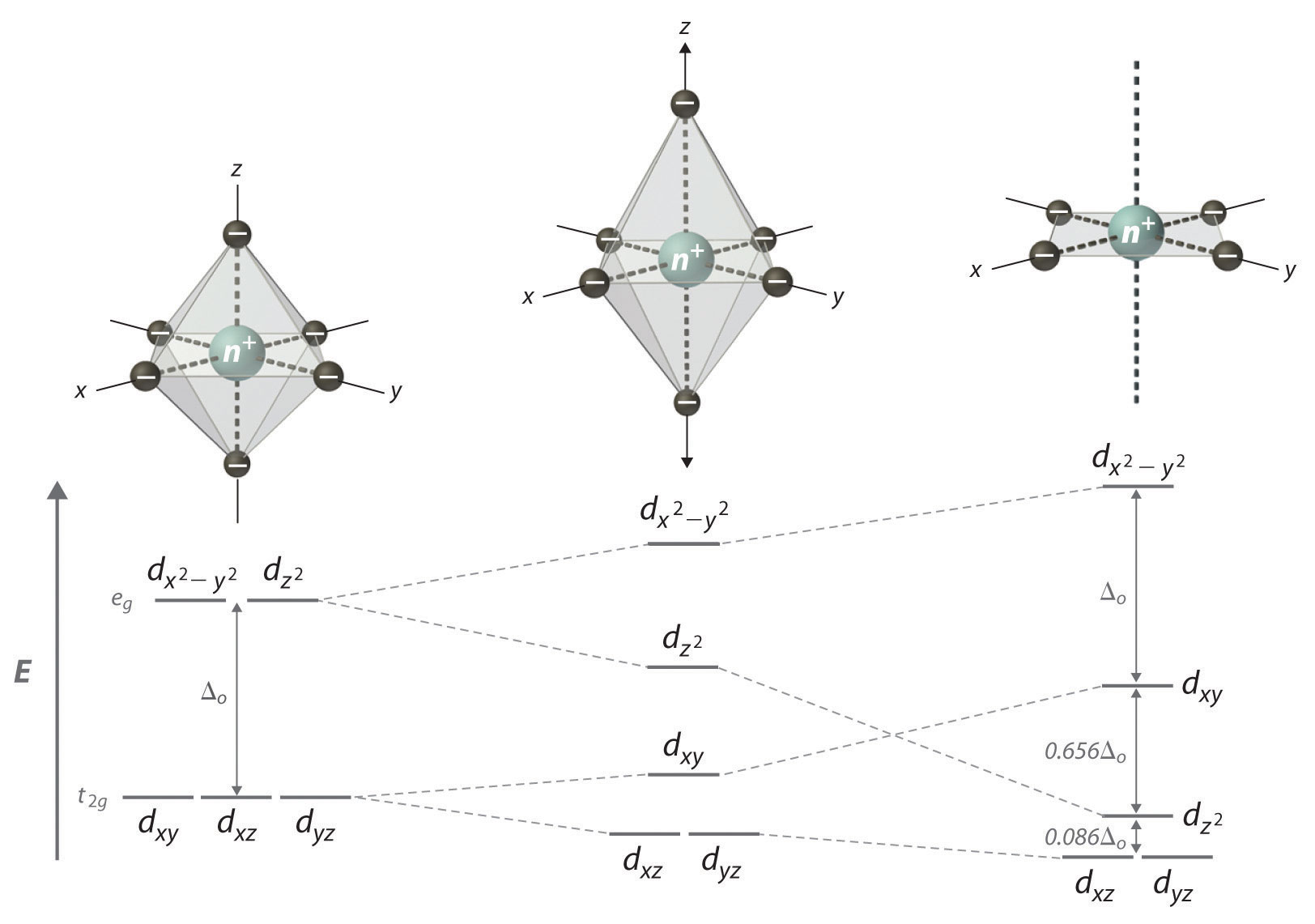
square planar structures are okay for
- maximises CFSE
- okay for strong-field ligands
- disfavoured because of steric effect
crystal field splitting energy is the energy difference
- increasing central metal ion charge increase crystal field splitting energy because the lower energy set of d-orbitals is stabilised more than the higher energy set since they are closer to the nucleus
crystal field stabilisation energy is the overall energetic advantage from splitting
pairing energy is represented as
depends on geometry, number of d-electrons, spin pairing energy, ligand character
for an octahedral complex:
- electrons in the more stable
subset is treated as contributing - electrons in the higher energy
subset is treated as contributing
the final answer is expressed as a multiple of the crystal field splitting parameter
for a tetrahedral complex:
- electrons in the less stable
subset is treated as contributing - electrons in the more stable
subset is treated as contributing
opposite of however many orbitals out of total is coefficient
high spin example:
What is the Crystal Field Stabilisation Energy for a high spin
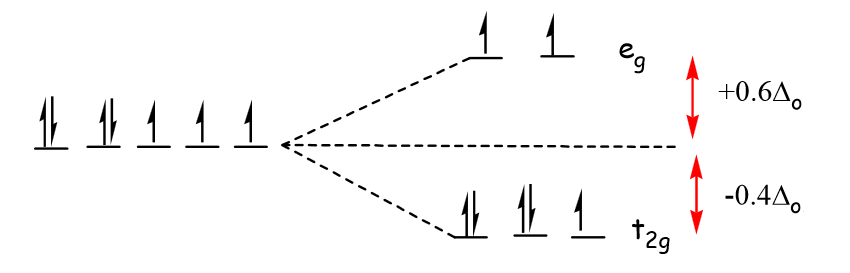
note that the pairing energy does not need to be calculated for high spin complexes since it is the same in the ligand field as well as the isotropic field
low spin example:
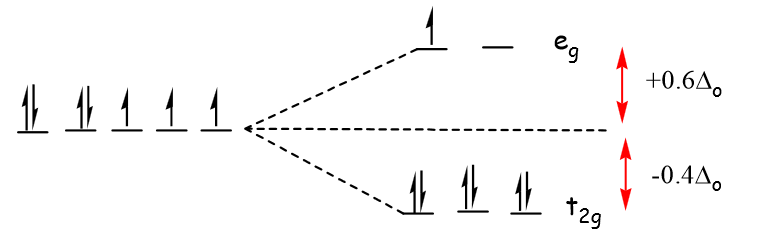
pairing energy
varies between
octahedral preference:
CFSE values can be calculated for non-octahedral ligand field geometries once d-orbital splitting is known and the electron configuration of the orbitals are known
the energies of these geometries can be compared to octahedral CFSE. this is called the octahedral site preference energy
e.g. for a tetrahedral complex, the ospe would be
hard acid-base interaction: mostly electrostatic
charge dense
soft acid-base interaction: mostly covalent
largest orbitals/most overlap
comment on the fact that
hard acids like hard bases, soft acids like soft bases