chem further
coulomb’s law
where
and
if the charges are
force between a proton and an electron
potential energy of the electron
negative because it is bound to the proton
the schrodinger equation cannot be solved in cartesian coordinates, as the variables cannot be separated
SE for hydrogen atom
change of variables
can separate variables
solution:
3 quantum numbers will be generated instead of 1 for particle in a box - solutions to the SE
principle
orbital AM
magnetic quantum number
radial
where
e.g. for hydrogen 1s,
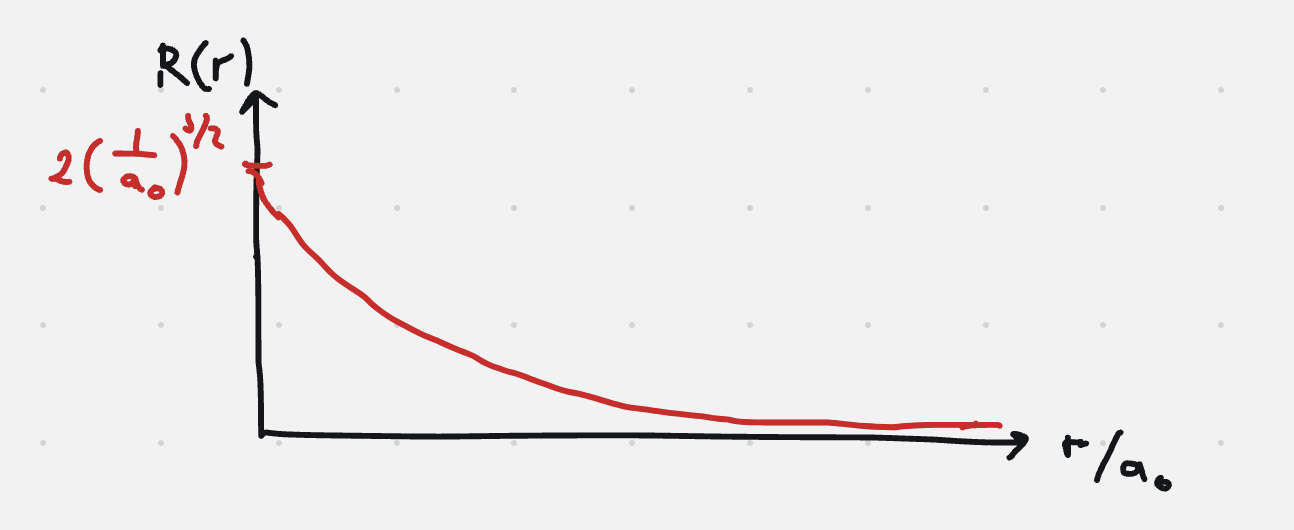
note, square modulus of wavefunction is the probability density, the wavefunction by itself doesn’t really have much of a physical representation
e.g. for hydrogen 3s,
notice the coefficient of the denominator in the exponential term
notice that the wavefunction has a quadratic, so we expect it to touch 2 twice
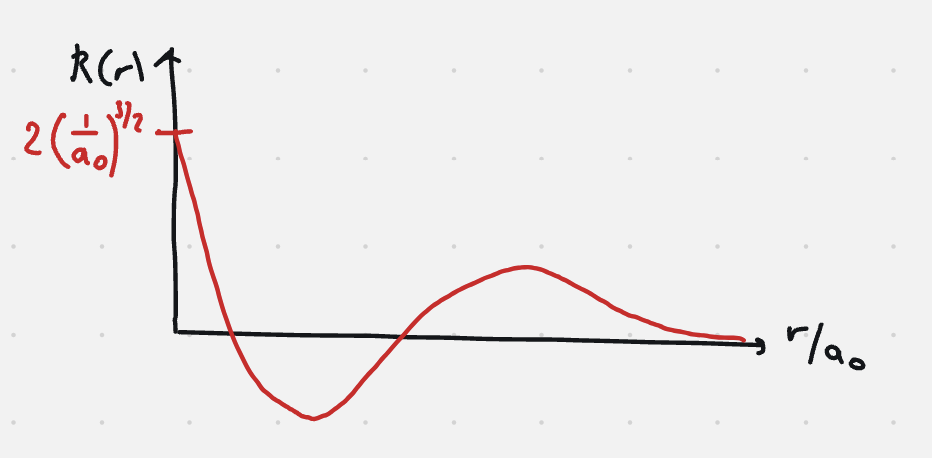
radial nodes are when the wavefunction touch 0, when the wavefunction changes sign
angular
complex wavefunctions
e.g. 1s
this means that electrons in the 1s orbital of the hydrogen atom has an equal chance of being found at any angle
e.g. p2
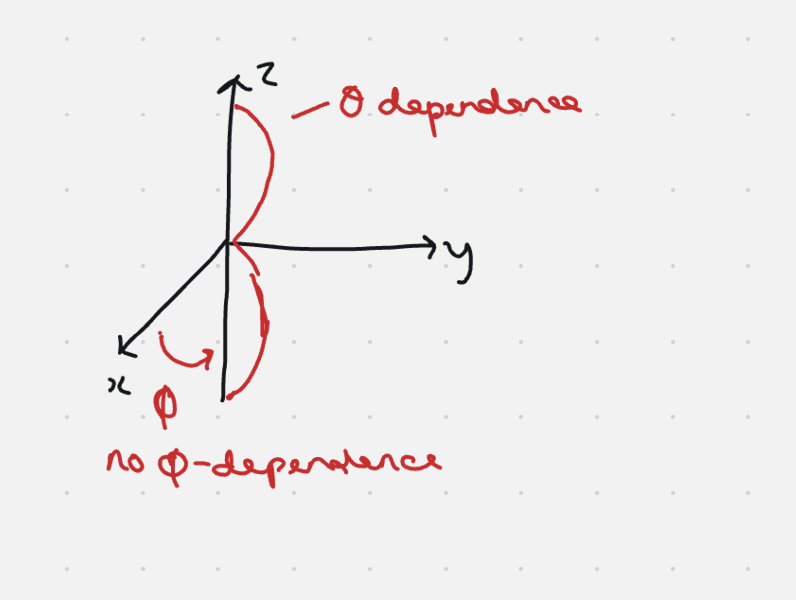
no
so almost like a volume of revolution around the
only works for
taking linear combinations of complex
1s
energy levels