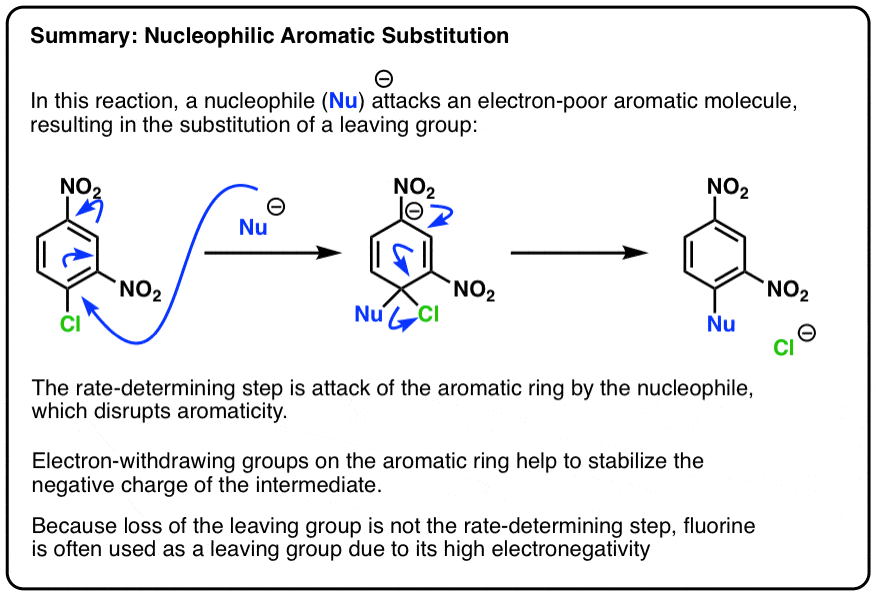
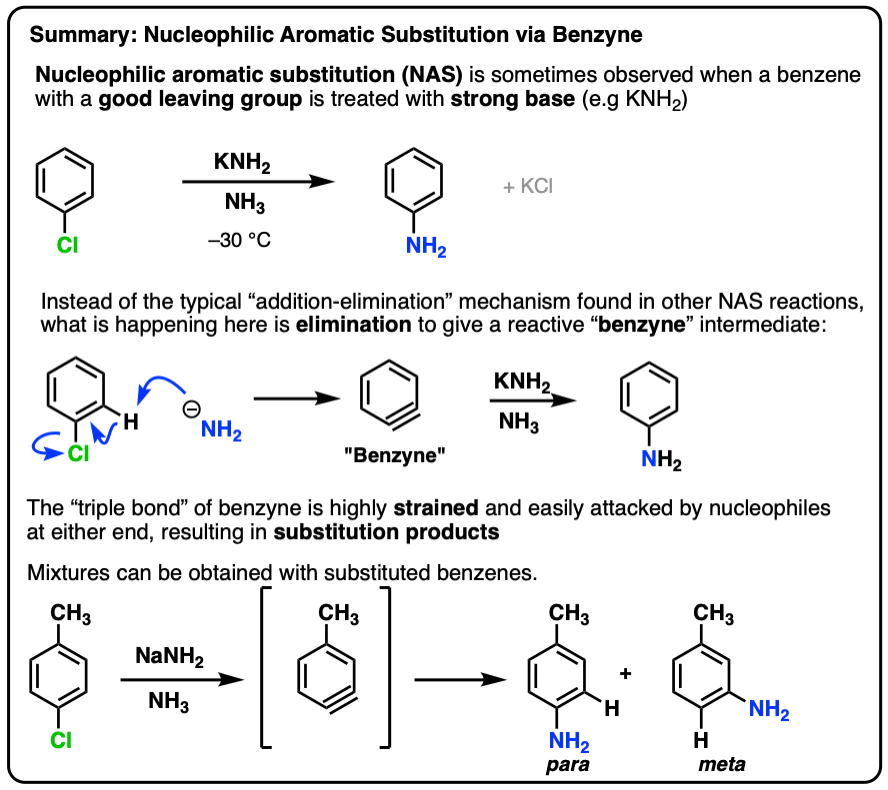
stepwise mechanism:
- nucleophilic attack on delta positive carbon of leaving group, aromaticity broken
- carbanion stabilised by EWGs on ring
- selectivity: ortho and para positions
- forms the meisenheimer intermediate
- elimination of leaving group
kinetics
- rate determining step: addition step
- elimination has little influence on kinetics
- more EWGs stabilise negative charge better
- stabilising intermediate, reducing activating energy, increasing rate
identity of leaving group:
- but
is significantly faster due to inductive effect on carbon making it significantly more - less influence than concerted
concerted mechanism:
- bonds broken and formed simultaneously in single step (rate determining step)
not possible, since backside attack of not possible (inside the ring) - identity of leaving group more important, since bond dissociation energy is relevant now, since this occurs in the rate determining step
evidence for concerted SNAR mechanism:
-
kinetic isotopic effect
-
not observing of meisenheimer intermediate (reaction inside NMR machine)
-
meisenheimer like transition state
-
continuum
-
Primary Kinetic Isotope Effect:
- Definition: The isotopic substitution happens at the bond being broken or formed in the rate-determining step.
- Magnitude: Typically large
-
Secondary Kinetic Isotope Effect:
- Definition: The isotopically substituted atom is not directly involved in the bond-breaking/forming step (i.e., at a remote position).
- Magnitude: Generally small