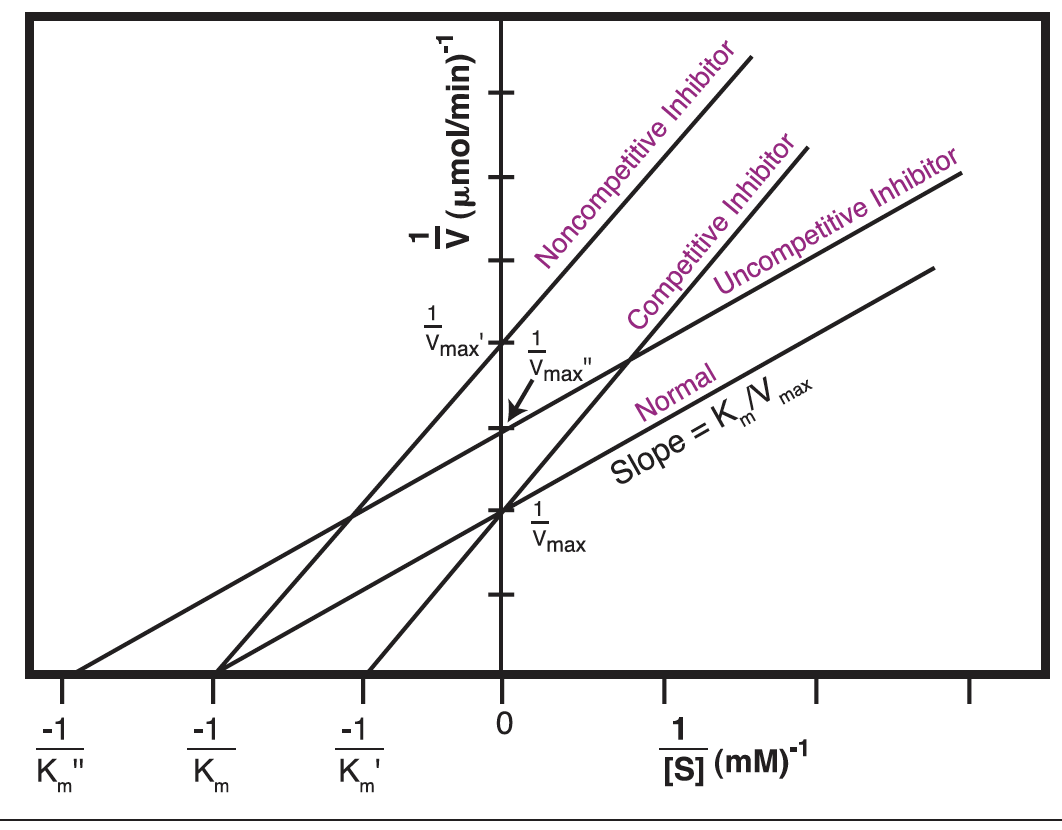
reversible, competitive inhibitors
-
structural analogues of the substrate
-
competes with the substrate for the active site of the enzyme
-
doesn’t affect
- inhibitive effect can be outcompeted by increasing the substrate concentration
- i.e. the substrate will ultimately occupy all binding sites
- enzyme-catalysed reaction in the presence of a competitive inhibitor remains unchanged from normal
-
affects
- a higher substrate concentration is required to reach
, to overcome inhibitory effects of the competitor
- a higher substrate concentration is required to reach
reversible, non-competitive inhibition
-
generally structurally unrelated to the substrate
-
binds to an allosteric site
-
theoretically, the substrate and the inhibitor can bind to the enzyme at the same time
-
the inhibitor distorts the active sites, reducing the effectiveness of the
complex - alters the conformation of their catalytic residues
-
doesn’t affect
- effect of this inhibitor cannot be reversed by increasing substrate concentration
- enzyme-substrate affinity unchanged as both
and can bind at the same time
-
affects
- reduction due to reduced effectiveness of
complex
- reduction due to reduced effectiveness of
uncompetitive inhibition
- do not react with the free enzyme
- combines with the
complex to slow down or prevent formation of product - affects
- affects
irreversible / suicide inhibition
-
reacts covalently with an amino acid side chain on the enzyme to form a stable complex that is permanently inactivated
-
some attach to active sites, known as “mechanism based suicide substrates”
-
reduces amount of active enzyme, kinetic effects similar to noncompetitive inhibitors
-
may affect
measures the affinity of the enzyme to the substrate, but it is based on the active enzyme present - if the inhibitor disallows
-
affects
- enzyme’s catalytic capacity is permanently reduced so
is reduced
- enzyme’s catalytic capacity is permanently reduced so